
Active Warrants in Louisiana
In Louisiana, a warrant stays active until served or recalled. The court that issued it keeps the case file, and the sheriff, police department, constable, or other named Louisiana agency keeps the record of service; those two record sets never merge into one public warrant list. No public search covers every Louisiana court and agency. The state leaves warrant records local. A Louisiana program may post selected probation or parole cases, while court and parish sheriff pages show their own records only. There is no statewide total. No complete coverage map of active Louisiana warrants exists either.
Louisiana Active Warrants Have No Full Index
Louisiana's warrant data sits inside closed systems. The Law Enforcement Telecommunications System, or LLETS, and the FBI's NCIC are limited to authorized justice-system users. Louisiana's Computerized Criminal History repository is a criminal-history record, not a live warrant search. Neither offers a public screen. No one can type a name and query every parish, city, or lower court in Louisiana. The Louisiana Department of Public Safety and Corrections does publish selected probation and parole notices. Its Most Wanted and Warrant Cases page covers program cases only. It has no parish coverage map. It claims no list-wide update interval. It does not speak for every open Louisiana court warrant, and a hit there cannot resolve a separate Louisiana city or parish matter.
How Statewide Active-Warrant Data Works
Louisiana publishes no statewide feed. Because no public feed exists, parish submissions, update intervals, and status fields cannot be inspected. LLETS and NCIC move data between authorized justice users. Neither is a public Louisiana warrant-search portal. A Louisiana warrant can sit in an internal system without ever reaching a public page. A Louisiana court's docket and the serving agency's record are separate files. Updates lag. A served, recalled, or transferred Louisiana order may take time to look right across systems, and the public may never see the internal change. No Louisiana statewide active-warrant count is published. No common parish reporting schedule exists either. A missing "last updated" label does not make a list current, and one local court's update cadence cannot speak for other Louisiana courts or sheriffs.
Note: A missing result in a Louisiana program or parish list does not prove that a Louisiana court has no active warrant.
Louisiana Warrant Lists Set Local Scope
A Louisiana sheriff's list shows only what that office chooses to publish, not a complete map of court process inside parish lines. Caddo Parish sets one example. Its official Louisiana warrant page expressly excludes fugitives from other agencies who may be located in the parish. Names run by last-name initial. The public table shows no issuing court, offense, bond amount, or case number. The next Louisiana parish may offer a different interface. Some publish no list at all. Caddo's headers show last, first, and middle name, plus date, age, and sex. Those columns do not name the issuing Louisiana court, and they cannot show whether another agency holds process too. A name-only match is only a lead. Confirm it with the Louisiana court and agency that own the record. The Caddo Parish Sheriff's warrant page shows its alphabet navigation and its coverage disclaimer, with no roster entry or identifying image.
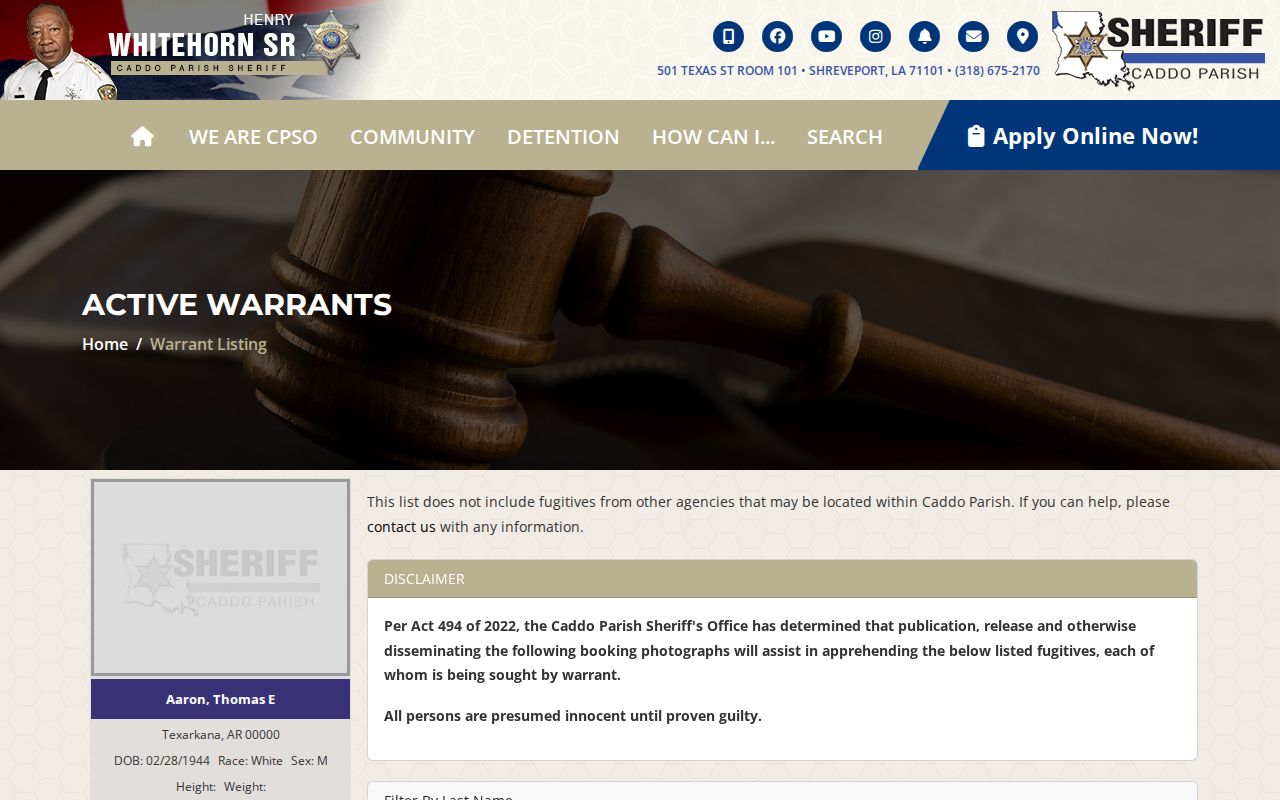
Use a Louisiana list only within its stated scope. Take any possible match straight to the Louisiana court and agency that serve it.
What an Active Warrant Shows
Louisiana has no shared public result row. Each local site picks which fields to show. Code of Criminal Procedure Article 203 sets what a written Louisiana arrest warrant must contain. Until the issuing court and the serving agency confirm the right person and the current order, a name match in Louisiana is only a lead.
| Warrant number | No statewide format No uniform public Louisiana warrant-number convention was found. |
|---|---|
| Person named | The written order names or reasonably describes the accused; a local site may publish fewer identity fields. |
| Offense | Article 203 requires the charged offense on the warrant, though a public list may omit it. |
| Issuing court | The order states its issuing municipality or parish; contact that court for the case record. |
| Bail | An eligible warrant may state bail when the magistrate can set it; omission does not decide availability. |
| Status | Ask the court if it is active, recalled, or transferred and the executing agency if it was served. |
Louisiana Warrant Records Have Separate Custodians
Start with the right office, because no single Louisiana desk holds a whole warrant file. The issuing court keeps the written order, the docket, the recall, and the next setting. The agency charged with service is separate. A sheriff, police department, constable, or marshal holds its own booking and service notes. So a Louisiana docket can show a court event before any service record catches up, and an agency page can miss the court's latest recall or transfer. Louisiana splits trial work across 43 district courts for general felony matters, while city, parish, mayor's, and Justice of the Peace courts take other cases under their own jurisdiction. District criminal records usually run through a parish Clerk of Court. Orleans runs a separate clerk. Take a city traffic citation to that city court. A JP court's constable may handle its process. The parish sheriff may publish none of these lower-court records. When the office is unclear, open the Louisiana parish directory and match the court named in your paperwork. The Attorney General's JP and constable directory can also locate an official by parish and jurisdiction, though it will not reveal whether a person has a warrant.
Note: A Louisiana court docket confirms the court's action; the sheriff, police, constable, or marshal confirms its own Louisiana service information.
Most-Wanted Lists and Warrant Roundups
No statewide amnesty portal or universal warrant-roundup schedule exists in Louisiana. Both are handled locally. The Louisiana Department of Public Safety and Corrections page covers selected probation and parole matters, and parish sheriff pages are local as well. Neither claims to list every active Louisiana warrant.
Key Point: Louisiana DPS&C publishes selected notices on its official Most Wanted and Warrant Cases page. The notices do not cover every Louisiana court warrant.
Use the Louisiana program's own instructions and confirm any possible case with the responsible program office and issuing court. No names, photographs, or roster entries are reproduced here.
Louisiana Warrant Lists May Trail the Court
Baton Rouge City-Parish posts City Court warrants daily. Court-processed information can lag. Expect seven to ten days before it shows up. The posting cadence is the city's own statement. Interfaces and field layouts can change, so confirm anything urgent by phone. This is one Louisiana city-court example. It is not a statewide update guarantee. The official Court & Legal Services page explains the posting and processing interval.
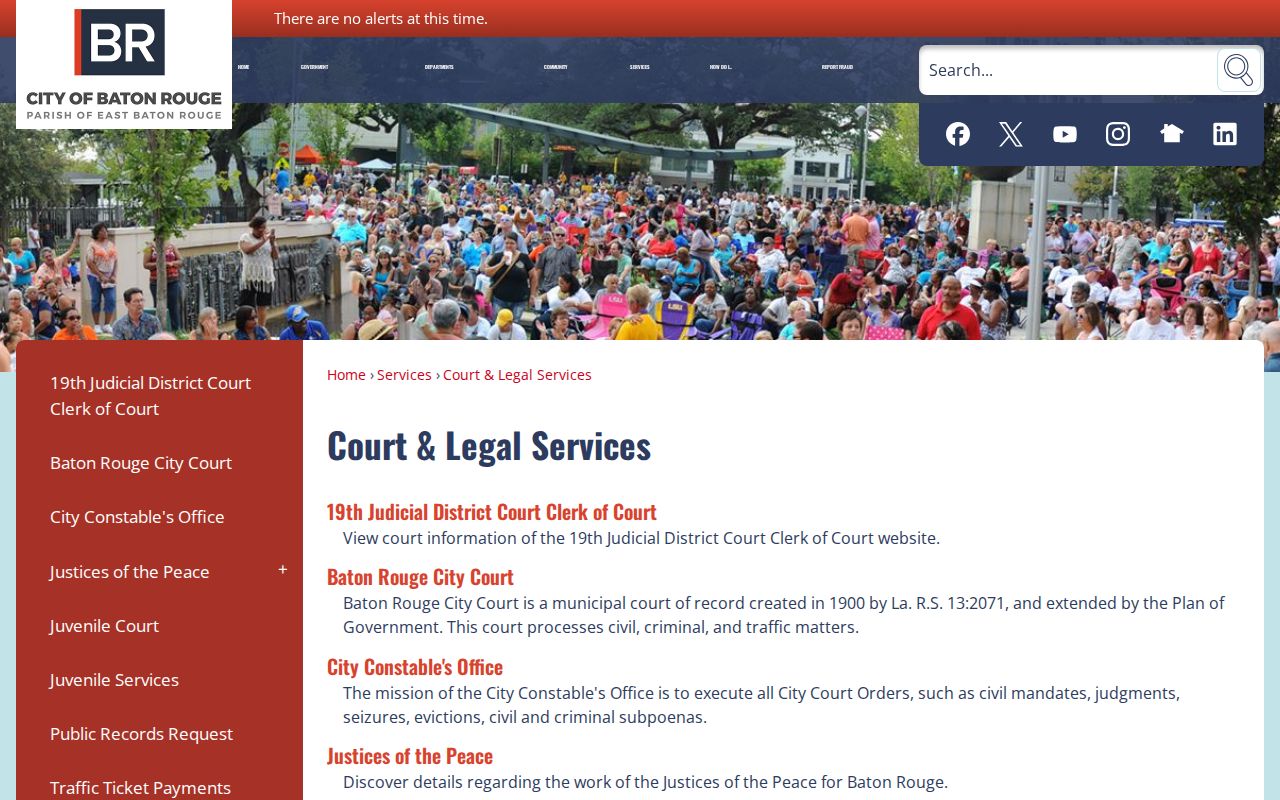
Need an urgent Louisiana status answer? Call the court's current contact route and ask staff to check whether its record shows the warrant active, recalled, or transferred.
Note: The seven-to-ten-day processing lag described by one Louisiana city court is not a statewide or shared parish-list update promise.
If Your Name Is on a List
Start with the clerk of the Louisiana issuing court. Ask whether the warrant is active, recalled, or transferred. Make sure the listing is really you. The court controls the case and next step. Then ask the Louisiana sheriff, police department, constable, or marshal named to execute the warrant about its service status and any appearance or surrender instructions. A Louisiana lawyer can help with a recall or quash request, a reset, a counsel-coordinated appearance, surrender, or bond. Under Article 202(H), a Louisiana magistrate who recalls a warrant that magistrate issued must now give notice to the district attorney and the executing agency. Confirm the change twice. Check the court record and the service record. Confirm any bond amount and payment process directly with the court or jail. Unsure which parish holds the case? Use the Louisiana parish directory to find the relevant local site. Louisiana Act 114 of 2026 took effect August 1, 2026. It added that recall-notice rule. Article 205 also states that a Louisiana arrest warrant remains in effect until executed or recalled. Those provisions clarify the order's legal life and status handoff. They create no public database, though, and no guarantee of immediate display changes online.
Important: Before appearing or surrendering, confirm instructions with the court and consider speaking with counsel; an active order can lead to arrest during Louisiana law-enforcement contact.
Louisiana Warrant Records and Public Access
Louisiana's Public Records Law generally permits inspection and copying, with exceptions. R.S. 44:3 holds the criminal-investigation and pending-litigation carve-outs. R.S. 44:31 addresses the right to inspect or copy. R.S. 44:32 bars a charge simply to inspect or review. Copy charges can differ. Juvenile records get separate protections under Children's Code Article 412. Sealing and expungement rules can also limit access. Send a request for an existing warrant order, recall notice, docket entry, or service return to the Louisiana office that holds it. A clerk may not certify an agency's current service status, and an ordinary Louisiana records request is not a live status check. If a custodian withholds a record, ask for the governing legal basis and whether a segregable public portion is available.