
Traffic Warrants in Louisiana
A Louisiana traffic warrant is court process, not a driving-history entry. It can follow an unanswered citation or a missed appearance, and the paperwork often sits in different offices: the ticket with one, the court file with another, the warrant and its service return with still others. The issuing court may be a Louisiana city court, a parish court, or a justice-of-the-peace court, depending on the charge and where it arose. Under R.S. 32:57.1, a judge or magistrate can notify the state when someone released on a written promise fails to appear, which can trigger a separate Louisiana license suspension; that notice is not a warrant and is not a public statewide search. Article 333 covers warrants issued after properly noticed failures to appear in covered criminal proceedings. Identify the Louisiana court first. Only then can you tell which rule applies, since a traffic warrant stays a Louisiana court record even when a license flag also exists.
Louisiana Traffic Warrants and FTA Notices
FTA simply means failure to appear. Under Louisiana's written-promise process, R.S. 32:57.1 gives you 180 days after DPS&C sends its notice to appear or pay the appropriate fine, unless the charge has already been disposed of. That window concerns a possible Louisiana license suspension, not the warrant itself. The issuing Louisiana court can still act separately, including issuing a warrant under the procedure that fits the case. Louisiana sets no single statewide capias-for-fines rule. Statutes use terms like "warrant of arrest" and "bench warrant," and a lower court may use a local label instead. Ask the Louisiana clerk what the term means on that docket, and ask which order resolves it.
- Written promise
- A signed undertaking to appear or respond to the traffic charge as directed.
- License hold
- A Louisiana OMV flag affecting driving privileges, separate from the court warrant.
- Capias
- A local label that varies; reviewed statutes set no statewide capias-pro-fine term.
- Bench warrant
- Louisiana court arrest process connected to a required appearance or court directive.
- Recall
- The issuing Louisiana court's withdrawal of its warrant; confirm the order and service record.
Note: The 180-day period belongs to Louisiana's written-promise law, not a general warrant deadline.
Statewide FTA and License-Hold Systems
Louisiana publishes no public full-warrant index. The statewide traffic system tracks license compliance, not city, parish, or JP court warrants. Louisiana OMV suspension instructions explain the agency's side of a qualifying written-promise case.
| System | What It Holds | Run By |
|---|---|---|
| Traffic citation and court case | Charge, appearance, payment, warrant, or recall order. | Issuing Louisiana city, parish, or other court. |
| Written-promise notice under R.S. 32:57.1 | Qualifying failure-to-appear notice and compliance period. | Louisiana court and DPS&C / OMV process. |
| OMV license status | Driving-privilege suspension and the proof needed to clear that flag. | Louisiana Office of Motor Vehicles. |
| LLETS / NCIC | Restricted justice-system records for authorized users, not a public warrant query. | Louisiana State Police and authorized agencies. |
State Police describes LLETS as a law-enforcement exchange, and LACCH holds controlled criminal-history information. Neither is open to the public as a warrant portal. A license-status check cannot confirm whether a Louisiana warrant is active.
OMV Proof After Louisiana Traffic Warrant
Once a Louisiana court resolves a qualifying traffic matter, OMV wants matching proof. The official Louisiana OMV written-promise and suspension instructions list the accepted proof categories and the license-flag fees.
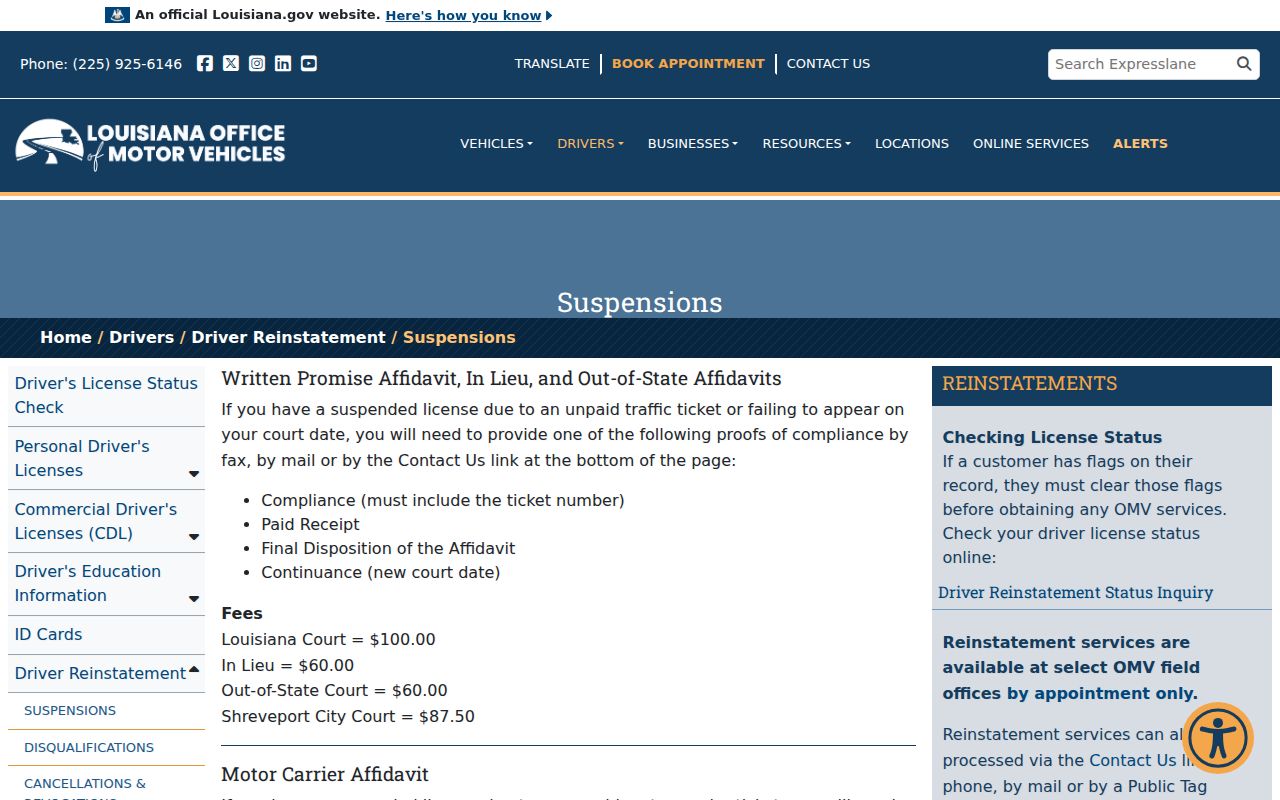
The affidavit covers the license process, not warrant status. Louisiana OMV requires "Compliance" proof to include the ticket number, and it also accepts a paid receipt, a final affidavit disposition, or a continuance showing a new date. Ask the Louisiana court directly whether the warrant was recalled. Keep its paperwork, and confirm where OMV takes it. Instructions list fax, mail, and contact routes, but no single update time covers every local court. Note: Louisiana OMV proof addresses a license flag; the issuing Louisiana court confirms the warrant and the case.
How to Check for a Louisiana Traffic Warrant
Start with the ticket, because the Louisiana court named on it controls the case. If it names a city court, call that court's traffic or criminal division. A parish sheriff list may leave out city court process entirely.
- Gather the citation, case number, full legal name, and date of birth. Note the issuing Louisiana court and city or parish.
- Ask the Louisiana court whether the case is open and a warrant was issued, recalled, or transferred. Confirm the next date and how to appear or request recall.
- If a justice-of-the-peace court is involved, use the Attorney General's JP and constable directory to identify the office by parish and jurisdiction. It is a directory, not a warrant search.
- Check the Louisiana sheriff, constable, or municipal agency responsible for service. Lists can omit other agencies; Caddo Parish says its list excludes other-agency fugitives.
- Use the Louisiana parish directory for local Louisiana court and sheriff channels. For an existing public document, ask its custodian under the Louisiana Public Records Law.
The Baton Rouge, Louisiana City Court FAQ sends bench-warrant questions to Criminal/Traffic staff, who can say whether a matter is active, recallable, or transferred. Those are local numbers, not a statewide hotline. A records request pulls an existing disclosable document, not live warrant status.
Louisiana Traffic Warrant Search Gaps
A Louisiana sheriff search and a city-court docket answer different questions. A Louisiana municipal or JP court may assign service to a constable, marshal, or police agency, so its order may never appear on a parish sheriff list. Stop at that list and you can miss a lower-court case. No public statewide Louisiana query fills the gap. LLETS and NCIC stay restricted. DPS&C's Louisiana "Most Wanted / Warrant Cases" page covers a selected probation and parole program, not every court warrant. OMV status is narrower still: it reports a license flag, not the citation or warrant history.
Key point: A blank Louisiana sheriff or OMV result does not prove that a city or parish court has no active traffic warrant.
Check the Louisiana court named on the ticket first. Then ask the agency directed to execute its order. If that is unclear, the clerk who holds the service record can tell you. Note: Louisiana court, sheriff, and OMV records have different custodians, so one negative result answers only one search.
Paying or Lifting a Traffic Warrant
Louisiana offers no statewide "pay or lift" portal. The issuing Louisiana court controls the citation and the warrant, while Louisiana OMV controls a qualifying license suspension. A reinstatement fee is not a traffic fine. Paying the court alone does not prove OMV lifted a flag.
- Confirm the Louisiana court, case number, warrant status, and amount with the clerk. Avoid copied payment links and third-party notices.
- Ask what resolves the case. The issuing Louisiana court may require payment, an appearance, a continuance, or another remedy.
- Ask whether the court issues a recall or compliance document and which Louisiana agency receives it. Confirm the service record reflects a recall.
- For a related OMV suspension, submit accepted proof, pay any reinstatement fee, and check license status separately.
Caution: Until the issuing Louisiana court confirms a recall or other resolution, treat a Louisiana traffic warrant as active and ask counsel or the Louisiana court about safe next steps.
Article 211.1 of Louisiana's Code of Criminal Procedure lets officers issue a summons instead of making an arrest in certain same-jurisdiction misdemeanor or traffic cases. The choice is discretionary. It does not replace court instructions, and a warrant may still require an appearance or lead to arrest.
Louisiana Traffic Warrant Fee Categories
Louisiana OMV lists reinstatement fees for license flags. Those are not warrant bonds. Court fines and costs, bond, copy charges, and OMV fees all stay separate in Louisiana, and the OMV FAQ draws the line between what you pay the court and the reinstatement amount owed to OMV.
| OMV category | Published amount | What it applies to |
|---|---|---|
| Louisiana Court | $100 | Qualifying Louisiana court traffic flag; separate from fine and bond. |
| In Lieu | $60 | OMV reinstatement category; verify whether it fits the case. |
| Out-of-State Court | $60 | License flag category; does not clear the other court's case. |
| Shreveport City Court | $87.50 | OMV category; any city court fine remains separate. |
Louisiana OMV posts listed amounts, not a traffic-warrant bond schedule. The state sets no uniform bond, sheriff confirmation fee, or copy charge. Confirm the fee and payee before paying.
Note: A settled ticket may still need proof and a separate Louisiana OMV reinstatement payment.
Traffic Warrant vs Driver Record
A Louisiana traffic warrant is judicial process. A Louisiana driver record is just a licensing file. OMV status tells you nothing about the court docket, warrant order, or service record, so confirm the order with the court and any license flag with OMV.
| Question | Traffic warrant | Driver-license record |
|---|---|---|
| What it records | A court order, case status, and any recall or execution return. | License privilege and administrative flags. |
| Who keeps it | Issuing Louisiana court and agency directed to serve the order. | Louisiana Office of Motor Vehicles. |
| How to verify | Ask the Louisiana city, parish, or JP court and its executing agency. | Use Louisiana OMV status and reinstatement channels. |
| How it clears | Follow the Louisiana court order; confirm the service record changed. | Meet Louisiana OMV proof rules and pay any reinstatement fee. |
Fixing one record never updates the other. A Louisiana ticket may need a recall entry; a license flag may need separate OMV compliance proof. When a case involves both, check both.
Louisiana Traffic Warrant Recall in 2026
Louisiana Act 114 takes effect August 1, 2026. It added Article 202(H). Under it, a Louisiana magistrate may recall a warrant that magistrate issued, and written notice must go at once to the district attorney and the executing agency. Article 205 keeps a warrant alive until execution or recall. That clarifies the handoff from court to agency. The change builds no public Louisiana portal and sets no uniform update time. It also leaves a separate OMV suspension untouched. So check status with the issuing Louisiana court and the executing agency. Ask OMV about any written-promise license requirements. For an active warrant, a Louisiana lawyer or clerk can walk you through appearance, recall, or bond. Read the Act 114 record, Article 202, and Article 205.