
How to Check for a Warrant in Louisiana
Every Louisiana warrant check starts with the place and the court named on your paperwork. Pull out the ticket, notice, bond paper, or case record and read the headings. No public portal searches warrants across every Louisiana parish and city at once. Before you call, keep your full legal name, date of birth, citation or case number, and the latest court notice close at hand. The court controls the case record, while its assigned agency tracks service of the warrant. A sheriff's list may cover only selected Louisiana records, so treat it as one clue, not the whole answer.
- Identify the Louisiana parish or city and the issuing court on the paperwork. Louisiana calls its county-level local divisions parishes; a city-court file may be separate from a district clerk's record.
- Call the Louisiana court clerk, criminal or traffic division, or warrant desk. Ask if the order is active, recalled, or transferred and whether a new court date is set.
- Check the parish sheriff's official Louisiana page if it publishes warrants. Read its coverage note, then ask the assigned service agency to confirm its own status.
- For a city or Justice of the Peace matter, contact that Louisiana court and its constable or marshal. The Attorney General's JP and constable directory locates an office by parish and jurisdiction, but does not search warrants.
- For a Louisiana traffic case, ask the issuing court about the case and check OMV license status separately. Before paying or travelling, confirm the court's instructions for appearance, recall, counsel, surrender, or bond.
The Louisiana Public Records Law lets you request a specific docket entry or order from the office that holds it. That is not a live warrant check. Lawful limits can still cover juvenile, sealed, or investigative material. A missing or thin list result means one thing only: call the Louisiana issuing court. It is not proof that no warrant exists.
Louisiana Public Warrant Search Is Not Statewide
Louisiana publishes no public index that queries every parish's active warrants. The systems that come close serve agencies, not you. LLETS and NCIC are limited to authorized justice users, and LACCH is a fingerprint-based criminal history file. None of them is a public Louisiana warrant search, and no state source claims full parish coverage. The DPS&C page takes a narrower path: it posts selected probation and parole fugitive cases and points visitors toward local offices, with no completeness or update guarantee. Open the DPS&C program page for its scope. Its heading and instructions come before the individual case tiles, and the page cannot confirm a separate parish or city-court order.
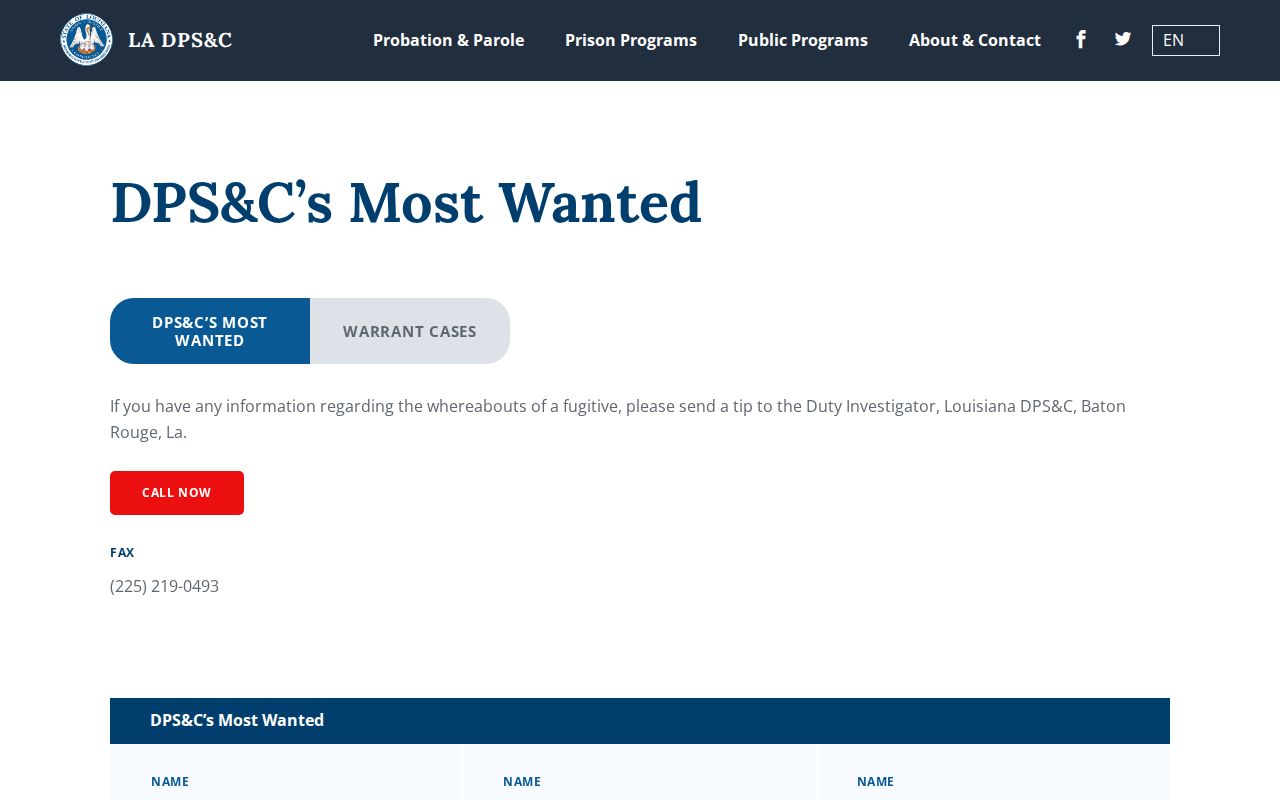
The program's tip route is not a Louisiana court-status line. It never replaces the issuing clerk.
A blank Louisiana program or sheriff result does not prove that no warrant exists. Ask the issuing court and the agency named to serve it.
Louisiana Sheriff Lists Have Local Coverage
Every Louisiana parish has a sheriff. The state constitution makes that sheriff the parish's chief law-enforcement officer, elected to a four-year term, and directs the office to execute court process. Orleans Parish sits under a distinct constitutional and legal arrangement, so the usual parish-sheriff route may not fit every Louisiana warrant. Each sheriff's office also sets its own rules for what appears on a public list. One may publish only records its deputies serve, while city police, constables, and marshals keep separate execution records and a lower court keeps its own case file. The Caddo Sheriff's official list says outright that it excludes fugitives from other agencies. That local caveat shows why a blank parish list is just one result. Confirm with the issuing court and the assigned agency before assuming anything.
The Louisiana Statewide Warrant System
Louisiana has no public statewide active-warrant search; the state network serves agencies. Louisiana State Police's BCII-LCJIS oversees criminal-history and law-enforcement information functions. LLETS and NCIC stay restricted to authorized justice users. LACCH is a fingerprint-based criminal history file, not a live Louisiana warrant roster, and its access follows separate state rules; a right-to-review request will not confirm a current Louisiana arrest warrant. Where does that leave you? With the issuing Louisiana court, which holds the case record, while a parish sheriff, city police office, constable, marshal, or other named agency tracks service and booking. A city-court warrant may stay purely local and never reach a parish list. The Louisiana warrant system overview explains the statewide layer, but your personal status still comes from the issuing court.
Louisiana Justice Data Has Separate Roles
Louisiana search results can mix criminal history, selected fugitive cases, and license status. Each record answers a different question and lives with a different custodian. An OMV result cannot confirm whether a court warrant exists or was recalled. None of these Louisiana systems replaces the issuing court's case record.
| System or Record | What It Covers | Public Warrant Search? |
|---|---|---|
| LLETS / NCIC | Authorized state and national justice-information exchange | No; justice-user access is restricted |
| LACCH | Fingerprint-linked criminal history, arrests and dispositions | No; not a real-time warrant roster |
| DPS&C Warrant Cases | Selected probation and parole fugitive matters | Public program page, not a complete list |
| OMV status | Driver-license flags and suspensions | No; it does not report every court warrant |
| Local court and service records | Issuing order, recall, return, booking, or service status | Ask the relevant custodian or check its stated public tools |
Louisiana State Police reports more than 100 AFIS livescan booking sites for fingerprints. That count measures booking intake, not Louisiana warrant volume or public search coverage.
Types of Warrants in Louisiana
Louisiana's Code of Criminal Procedure calls arrest process a "warrant of arrest." A bench warrant follows a missed court date or another court directive. A search warrant authorizes a search of specified property; it is not a personal case-status check. Fugitive, civil-attachment, and family-court process each carry separate purposes and remedies. Court screens may also say "capias," "alias capias," or "FTA." Statewide statutes give capias no single fine-collection meaning and no public status code. When a label appears, ask the issuing Louisiana clerk which order it describes and what action resolves it.
| Warrant Type | How It Arises | Who Issues It |
|---|---|---|
| Arrest warrant | Complaint affidavit and magistrate finding of probable cause | Qualified magistrate in the court with jurisdiction |
| Bench warrant | Properly noticed failure to appear or another court directive | Court that set the required appearance |
| Search warrant | Probable-cause application to search specified property or a place | Judge or magistrate under the criminal procedure code |
| Fugitive process | Interstate or federal coordination tied to an existing case | Issuing jurisdiction, with local execution partners |
Louisiana Arrest Warrants Changed in 2026
Two Louisiana acts took effect August 1, 2026. Act 114 added Article 202(H), which lets a magistrate recall a warrant that the magistrate issued. Immediate written notice must go to the district attorney and the executing agency. The change settles duration too. Article 205 now says a Louisiana arrest warrant remains in effect until executed or recalled. Act 672 arrived the same day. It revised Louisiana bail and failure-to-appear notice provisions, including Article 333's service details. Louisiana still lacks a public warrant portal. Neither act promises instant updates. After a Louisiana recall, ask the clerk for the order or docket entry, and ask the executing agency to confirm its service record.
Key statutes: Article 202 covers issuance and recall notice; Act 672 updates bail and FTA notice provisions.
What a Louisiana Warrant Record Shows
Louisiana Code of Criminal Procedure Article 203 spells out what an arrest warrant must contain. It names the State of Louisiana. It lists the issue date and parish or municipality. It identifies the person, states the offense, and commands arrest and booking. The magistrate's signature and title must appear too. In eligible noncapital cases, bail may be set. Those fields belong to the written Louisiana order, not to every online list. The state sets no statewide number format or display rule, and a brief sheriff row may omit the offense or the bond, so ask the issuing clerk for the full record.
| Warrant number | No statewide format Louisiana courts and agencies may use local numbers. |
|---|---|
| Person named | Name or reasonable description in the Louisiana order. |
| Offense | The charge stated; a public list may omit it. |
| Issuing court | Louisiana parish or municipality and issuing magistrate. |
| Bail | May appear in eligible cases; ask the Louisiana court. |
| Status and return | The clerk confirms court action; the assigned agency confirms service or booking. |
Louisiana status labels like "active," "served," "recallable," or "transferred" can mean different things. Ask the clerk what each field records.
Louisiana Restricted Records Have Limits
Some Louisiana records are closed by law. Juvenile files carry confidentiality protections under Children's Code Article 412, and Article 922 governs a juvenile sealing order. Adult expunged records in Louisiana are confidential under Code of Criminal Procedure Article 973. A pending criminal investigation or a specific sealing order can restrict access too. These are legal limits, not clearance. Ask for a specific existing document instead. A Louisiana docket entry, warrant order, recall, service return, or disposition will do. The clerk holds the court records. A sheriff, police office, constable, or marshal keeps its own execution record. Louisiana State Police are not a public desk for parish warrants. Neither is the Attorney General's fugitive unit. If a custodian withholds a record, ask for the legal basis and whether a public portion can be released.
Public Access to Louisiana Warrant Records
The Louisiana Public Records Law, La. R.S. 44:1 et seq., generally lets adults inspect or copy public records. Finding the right custodian matters. It may be a court clerk, a sheriff, or a police agency. That right does not open LACCH or LLETS. Nor does it guarantee an unserved Louisiana warrant file is disclosable. Louisiana R.S. 44:32 bars a charge just to inspect, though copies may cost money. R.S. 44:3 covers criminal-investigation and pending-litigation limits. When a Louisiana custodian doubts a record is public, R.S. 44:32(D) requires a written determination and reasons within five days. The clock excludes weekends and legal holidays. That is not a deadline to produce the record.
Key Rules:
R.S. 44:31 states Louisiana's general public-record access right for adults.
R.S. 44:32 covers inspection, copies, and written determinations.
R.S. 44:3 describes Louisiana criminal-investigation and pending-litigation limits.
A denial is not the end. Under R.S. 44:35, a Louisiana requester can seek court review after a denial or a failure to comply. The requester may also sue. That path opens if five statutory days pass without a written determination or an estimate of the time reasonably needed to review the record. The estimate is not a release date. Ask for the cited exemption and whether nonrestricted portions of the Louisiana record can be released.
Louisiana OMV Flags Are Separate Records
Louisiana R.S. 32:57.1 covers a person released on a written promise who misses a traffic appearance. A judge or magistrate may then notify DPS&C. Unless the charge is already disposed of, the person has 180 days after notice to appear or pay before a Louisiana license suspension may follow. A court warrant and an OMV flag are separate records. The Louisiana OMV suspension instructions list accepted proof and reinstatement fees. A license-status check does not query every court warrant. Resolve the citation with its Louisiana court first. Then send OMV the required proof and confirm each record with its own custodian.
| OMV Reinstatement Category | Fee | What It Is Not |
|---|---|---|
| Louisiana Court | $100 | Not court costs or a warrant bond |
| In Lieu | $60 | Not the ticket amount |
| Out-of-State Court | $60 | Not an out-of-state case resolution |
| Shreveport City Court | $87.50 | Not a statewide warrant fee |
OMV accepts several proofs for a Louisiana compliance submission. They include proof of compliance with the ticket number, a paid receipt, a final affidavit disposition, or a continuance showing a new date. Payment splits in two. The ticket payment goes to the court. Reinstatement goes to OMV. These are OMV reinstatement categories, not traffic-warrant bonds or ticket costs, so keep the court receipt, disposition, or new-date proof; an OMV payment alone does not recall a Louisiana court warrant.
Louisiana Warrant Terms
Louisiana court screens use local status labels. Ask the clerk which record a term describes before trusting it as final.
- FTA
- A failure to appear after Louisiana's notice rules apply.
- Recall
- The issuing Louisiana court withdraws its warrant.
- Bench warrant
- Court arrest process tied to a missed date or directive.
- Capias
- A local Louisiana label; ask the court what resolves it.
- OMV flag
- A license restriction, separate from a Louisiana arrest warrant.
Louisiana statutes set no shared public capias code. Read each label against the local order and docket.
Resolving a Louisiana Warrant Takes Confirmation
No statewide amnesty portal exists. Nor does Louisiana run a surrender hotline or universal payment process. The issuing Louisiana court controls the case, its named agency handles service, and OMV handles a separate traffic flag. Confirm the order and local instructions before travelling, paying, or surrendering.
- Ask the Louisiana court if the warrant is active, recalled, or transferred, and confirm the next date and any bond.
- Ask whether Louisiana procedure allows a recall motion, reset, attorney-arranged appearance, or another court-approved step.
- If directed to surrender, confirm the Louisiana intake office, timing, and bond options with the assigned agency.
- Keep the receipt, continuance, or recall order; check that the execution record reflects the Louisiana court's action.
- For a separate OMV flag, send the required proof and check the license record with OMV.
Louisiana sets no uniform bond schedule. Confirm the amount and type with the issuing court or the jail, because a bond may address custody while the case stays open. A payment receipt in Louisiana does not by itself prove a recall. Ask a lawyer about a recall or a controlled appearance. The local public defender can tell you if you qualify for help. The state runs no standing safe-surrender or warrant-roundup program; the 2024 Caddo event was local and time-limited, not an ongoing Louisiana offer.
Louisiana Justice Technology Is Not Public Search
Louisiana has built impressive justice technology, but none of it is a public warrant search. The Louisiana Supreme Court's 2025 report describes ICJIS coordinating data standards since 1999, with a secure broker server that began operating in 2025. That interagency exchange guarantees no public lookup, and it does not show that every Louisiana warrant is included. The report's 578,107 district-court filings count caseload, not warrants. Louisiana State Police reports more than 100 fingerprint livescan booking sites on its AFIS network. Other changes touch training and authority rather than data. Act 222 created an Attorney General arrest-warrant course in 2009, and Louisiana justices of the peace must hold certification and take recurring training before issuing warrants. Act 264 codified the Attorney General's fugitive-assistance role in 2025. Neither is a database program. The Louisiana fugitive-unit statute lays out help for law-enforcement agencies, while the LSP BCII-LCJIS page details secure system roles and access limits.
Need to know about a current Louisiana warrant? Call the issuing court, then check with the sheriff or police agency tasked with executing it.
Find Warrants by Parish in Louisiana
Louisiana counts 64 parishes, per the official locality directory. Each Louisiana parish or city court keeps its own case file. The assigned sheriff, police agency, constable, or marshal handles service. A sheriff list may miss city-court process or another agency's fugitive, so these six populous metro parishes are local starting points, not statewide warrant coverage.
East Baton Rouge Parish
Baton Rouge · largest 2025 population estimate; City Court and district matters use distinct channels.
Jefferson Parish
Gretna · the sheriff lists Warrants Processing and a separate public-records custodian.
Orleans Parish
New Orleans · criminal district, city, and traffic cases have distinct court routes.
St. Tammany Parish
Covington · the sheriff's Criminal Records division holds district-court warrants routed through the agency.
Lafayette Parish
Lafayette · the sheriff lists a warrant contact apart from its public-records office.
Caddo Parish
Shreveport · the sheriff publishes an A–Z list that excludes other agencies' fugitives.
Browse the full directory of all 64 Louisiana parishes to reach the local records site. Confirm status, bond, recall, and the next court date with the issuing Louisiana court.