
Municipal Court Warrants in Louisiana
City courts are a distinct tier of Louisiana's judiciary, handling traffic, local ordinances, and certain misdemeanors, and a Louisiana municipal warrant is simply process from one of them. The state has 48 of these courts sitting alongside district, parish, juvenile, and family courts. Each one keeps its own case files through a clerk or administrator, so a parish-level search may never surface the city clerk who actually holds the record. Service varies too. A constable, a marshal, a police department, or a parish sheriff may carry out the order, and the assigned agency keeps its own record while the issuing Louisiana court controls the warrant and the next court date. R.S. 13:1894 spells out city-court criminal jurisdiction. Work from the court named on your paperwork, not from any statewide list, and remember that Louisiana's county-level divisions are parishes.
Louisiana Municipal Warrants in City Courts
Those 48 city courts stand apart from Louisiana's 43 district courts and three parish courts, and the Louisiana Supreme Court's 2025 Annual Report lays out where they fit in the structure. A Louisiana city-court warrant stays in that court's case file even when a parish sheriff serves it. For a look at how one municipal court organizes civil, criminal, and traffic matters, the Baton Rouge City Court divisions page is a useful local example rather than a statewide portal:
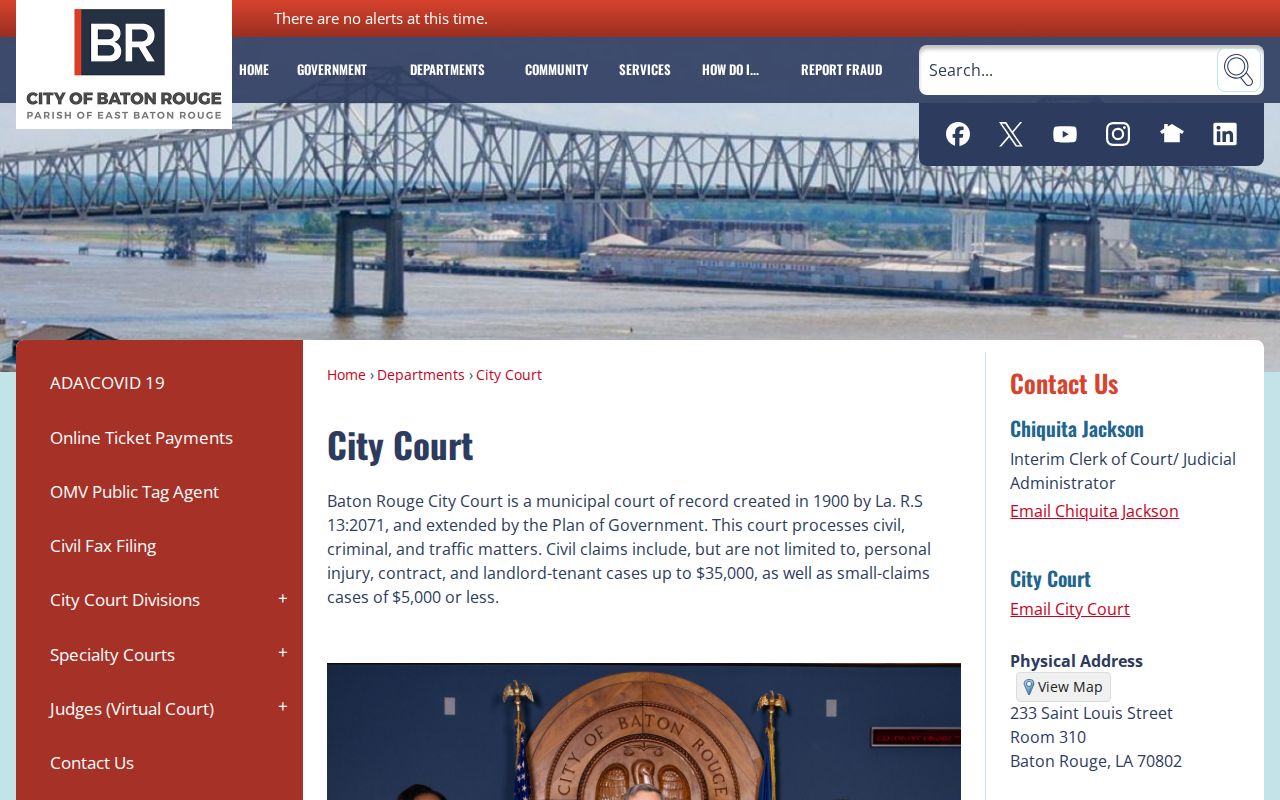
What you see there is court navigation, not a warrant roster. Every other Louisiana city court has its own clerk and contact route, so match the city printed on your paperwork.
How Municipal Warrants Differ From Parish Warrants
Parishes are Louisiana's county-level divisions. A city-court warrant lives with the Louisiana court that issued it, while a district-court warrant turns up in the parish Clerk of Court's criminal records. The serving agency may keep its own return or booking entry, which can lag behind the court file.
| Feature | Municipal court warrant | Parish or district warrant |
|---|---|---|
| Issuing court | City court within its Louisiana jurisdiction. | District or parish court handling the case. |
| Case record | Louisiana city court clerk or administrator. | Parish Clerk of Court; Orleans criminal matters use its separate criminal district clerk. |
| Service record | Louisiana city constable, marshal, police, sheriff, or other assigned agency. | Parish sheriff or agency named for service. |
| Public coverage | Louisiana local court inquiry; no complete public statewide index. | Local clerk or sheriff channel; lists may omit other agencies. |
A Louisiana sheriff is a key contact for service, but the sheriff's website is not the record system for every city court. The state's sheriff law sets a general role, and a municipal order can name another agency to serve it. When both court levels are involved, see the bench warrant procedures.
Louisiana Municipal Warrants Can Miss Sheriff Lists
An empty parish sheriff page proves nothing about a city warrant. No official public full-warrant search exists in Louisiana, and a sheriff's list covers only what that office publishes or serves. A city constable or police agency can hold a separate service record entirely. R.S. 13:2583 gives each Justice of the Peace court a constable, which is why you should identify the Louisiana issuing court and its service office before searching anywhere else. The Louisiana State Police BCII-LCJIS page covers restricted law-enforcement information, not a public warrant list. So call the court. Baton Rouge City Court, for example, routes bench-warrant questions to Criminal/Traffic staff, who can say whether a warrant is active, recallable, or transferred, and that direct inquiry often beats a stale online result. Its payment answer in the Louisiana City Court FAQ shows one court's approach:
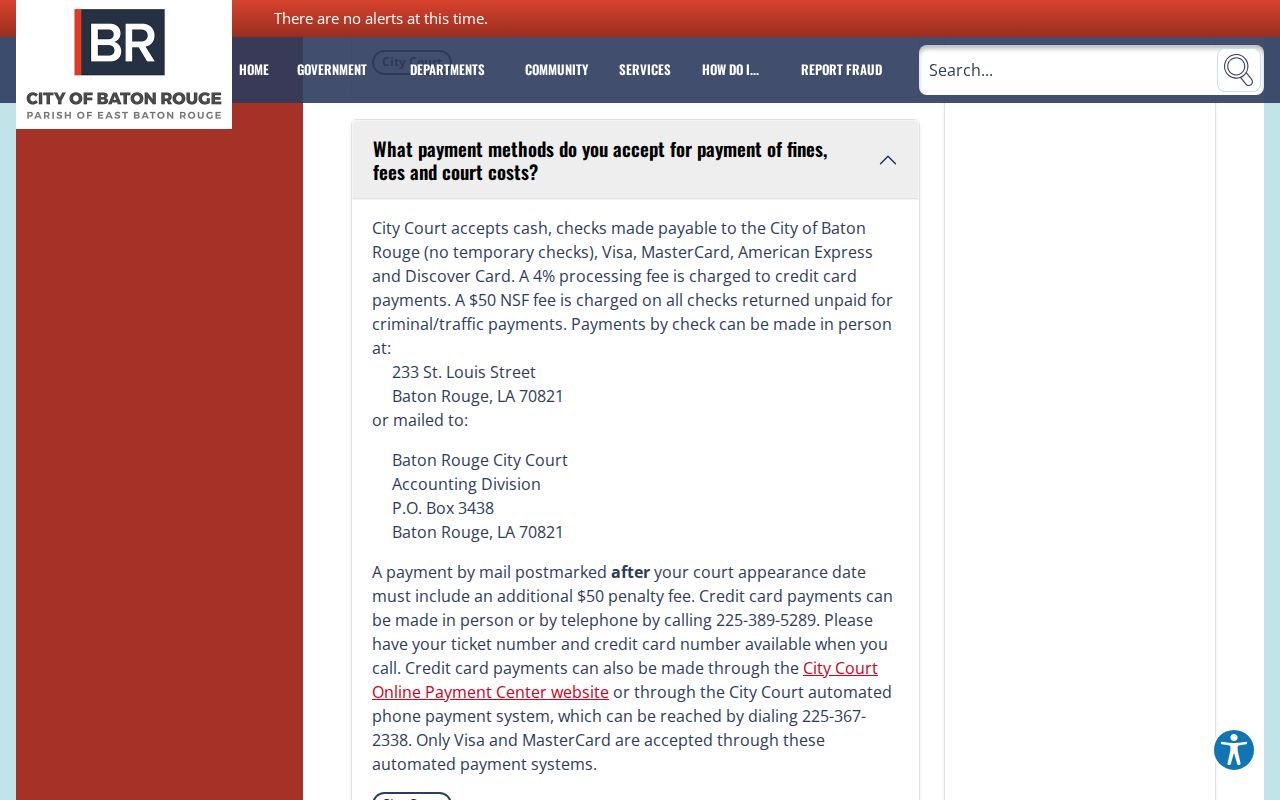
Baton Rouge lists a $50 late-mail penalty after the court appearance date, a 4% card-processing fee, and a $50 returned-check fee on certain criminal and traffic payments. Those are local terms, not statewide warrant fees. Paying a balance does not guarantee a recall or an updated service record.
Key point: A Louisiana parish sheriff list, city court lookup, and service-agency record cover different sources. A no-result from one is not a statewide clearance.
How to Check a Municipal Court Warrant
Start with the Louisiana court named on the citation, summons, or notice. Unsure which one? Identify the city and the type of matter first. Local traffic, ordinance, and misdemeanor files sit apart from district dockets and sheriff lists.
- Gather the Louisiana citation or notice, case number, full legal name, and date of birth. Record the city, parish, and court named on it.
- Contact the Louisiana city clerk or criminal/traffic division. Ask whether the file shows an active warrant, recall, transfer, hearing date, or balance due.
- Ask which Louisiana constable, marshal, police department, or sheriff is responsible for service. Confirm service with that agency, but ask the court about case status and recall.
- For a Justice of the Peace case, use the Louisiana Attorney General's JP and constable directory by parish and jurisdiction. It lists officials, not warrants.
- Use the Louisiana parish directory for local Louisiana court and sheriff pages. For a copy of an existing public record, ask its custodian under the Public Records Law.
In Baton Rouge, the FAQ gives 225-389-5278 and 225-389-5288 for Criminal/Traffic bench-warrant questions, plus 225-389-5294 for general help. Those contacts can explain status, recall, or transfer. Ask what proof or appearance is required.
Louisiana Municipal Warrant Checks by Court
The Louisiana Public Records Law (R.S. 44:1 et seq.) lets you request an existing record from its custodian, naming the case and the item you want, such as a docket entry, warrant, recall order, or payment disposition. Inspection is generally free under R.S. 44:32, though copy charges depend on the record and the custodian. A records request is not a live warrant check. R.S. 44:3 carves out criminal-investigation exceptions, and juvenile or sealed matters carry extra limits. If access is denied, ask why. For current status, contact the Louisiana court and its assigned agency directly.
- Municipal warrant
- Process issued by a Louisiana city court.
- Bench warrant
- Warrant tied to a missed appearance or Louisiana court directive.
- Capias
- A local label; no statewide Louisiana capias-pro-fine definition was found.
- Recall
- A Louisiana court's withdrawal of its warrant; check agency notice.
- Executing agency
- Agency directed to serve the warrant and report the result.
The court entry and the service return can differ while an update is pending. Keep your case number and any proof of payment, appearance, or recall, and ask the Louisiana clerk to recheck.
Note: A Louisiana records request seeks an existing document, not restricted-system access or a prediction of warrant status.
What a Municipal Court Warrant Shows
What shows up on a Louisiana municipal warrant depends on the system the issuing court keeps. Article 203 spells out what a written warrant must contain: the state, the date and place, the person or a reasonable description, the offense, a command to arrest and book, and the magistrate's signature and title. Bail can appear when the magistrate is able to set it. A public page may leave fields out.
| Warrant number | Court-assigned number Use the citation or order number. No statewide Louisiana format was verified. |
|---|---|
| Person named | Name or description; verify identifying details with the Louisiana clerk. |
| Charge | Louisiana offense, traffic matter, or ordinance attached to the case. |
| Issuing court | Louisiana city court and jurisdiction where the case was filed. |
| Bond or fine | Ask the Louisiana court whether bail is set; keep it distinct from fines, costs, and license fees. |
| Status | Ask the issuing Louisiana court whether it is active, served, recalled, or transferred. |
Louisiana city courts use no shared case-number format, public-list layout, or status codes. So a thin result may leave out the issuing court, the charge, the bond, or the case number. A name alone settles nothing; ask the clerk for the actual court entry, and ask the serving agency for its return. Article 203 spells out what a warrant must contain. It is a statute, not a sample case, so confirm any Louisiana record with the issuing city court.
Louisiana Municipal Warrant Recall in 2026
Recall rules changed on August 1, 2026. That day, Louisiana Act 114 added Article 202(H), which lets a magistrate recall a warrant the same magistrate issued, with written notice to the district attorney and the executing agency right away. Article 205 keeps every warrant live until it is executed or recalled. This notice duty is not a public lookup system, though. Ask the issuing court whether the rule covers your Louisiana municipal warrant and what paperwork it wants. Then check the recall order in the court file and with the service agency, because state law sets no fixed update window.
Record path: Court order → clerk records recall → notice goes to agency → agency confirms service status. See the official Act 114 record and Article 205.
Note: Louisiana's 2026 rule sets no statewide update schedule for city courts or sheriff systems.
Resolving a Municipal Court Warrant
Louisiana has no single process for paying off or surrendering on a municipal warrant. Each issuing city court decides what closes its case. That may mean a fine, a payment plan, a court appearance, or bond. Ask the clerk what applies before you pay or travel.
- Confirm the issuing Louisiana court, case number, and status: active, recalled, or transferred.
- Ask if the Louisiana court requires an appearance, motion, fine, payment plan, community service, or bond; options vary by case.
- Follow the Louisiana court's payment or appearance instructions. If unable to pay, ask about a hearing or relief before missing another date.
- Get a receipt or court entry. After recall, ask which Louisiana agency was notified and confirm its record changed.
Caution: A Louisiana municipal warrant remains a court matter until the issuing Louisiana court confirms its resolution; a payment receipt alone may not show recall or service status.
Article 333 governs warrants issued after properly noticed failures to appear in covered criminal matters. These warrants do not expire on any statewide clock. Talk to a lawyer or the Louisiana court about bond and arrest risk before you turn yourself in.
Louisiana Municipal Warrants and OMV Flags
A Louisiana municipal traffic case can also bring a Louisiana OMV license flag through the written-promise process. That flag concerns driving privileges only. It is not the warrant and not the court balance. Ask the city court about the warrant, and ask OMV about proof of compliance; the Louisiana traffic warrant page walks through that separate process.
| Record or payment | What it changes | Office to confirm |
|---|---|---|
| Louisiana municipal court fine or cost | Amount due in the local case; does not itself prove recall. | Issuing Louisiana city court. |
| Municipal warrant | Court process and its service or recall status. | City court and assigned executing agency. |
| OMV reinstatement fee | License flag after the required proof and fee are processed. | Louisiana Office of Motor Vehicles. |
Baton Rouge City Court's FAQ lists its local payment methods and transaction charges, not a statewide warrant fee. Ask that court directly for the current total, accepted payments, and proof of recall.
Note: A Louisiana warrant, court balance, and OMV flag are separate records and steps.